We have reported and further documented that H.O.M.E. wasn’t designed to create affordable or even middle-income housing. Instead, it eliminated regulations and standards that would have inhibited the market from building housing under H.O.M.E. that is prohibitively expensive and grossly incompatible with the surrounding neighborhood. But those facts haven’t stopped organizations and public figures from embracing H.O.M.E. or, worse, from misrepresenting its impact on housing prices in campaign statements claiming their “zoning reforms” (H.O.M.E. and Density Bonus 90) have made housing more affordable:
“Council Member Zo Qadri led historic zoning and housing reforms… That led to abundant homes for an affordable Austin.”
“He’s [Ryan Alter] lowered housing costs. Largest rent declines in the nation. Greatest decrease in home prices in Texas, and top 5 nationally”. “Four years later, we’ve achieved some amazing results,” Alter said. “Housing costs are lower than any other major city in the country.
José Velásquez – “Wins for Affordable Housing and Anti-Displacement”
H.O.M.E. applications were first accepted in February (H.O.M.E. 1) and August (H.O.M.E. 2) of 2024, and Density Bonus 90 (DB90) in March of 2024. But Austin’s construction boom began years earlier, according to a 2020 report of the City Demographer – long before H.O.M.E. and DB90 and at a scale that contradicts the narrative that the City’s land development code was “severely constraining” production:
“The amount of multifamily housing under construction right now within the City of Austin is simply phenomenal—a phenomenon running orthogonal to the false narrative that housing production within the City is somehow severely constrained by the City’s land development code.”
Austin led the nation in residential building permits issued per capita between 2017 and 2021, before H.O.M.E. and other density-inducing Code amendments were adopted. Census data show that 120,937 new units were added from 2015 to 2024. By 2024, when the City began accepting applications for these zoning amendments, the construction boom had already created a housing surplus, higher vacancy rates, and falling rents across the Austin Metro area. Fewer units have been built since the 2024 zoning changes:
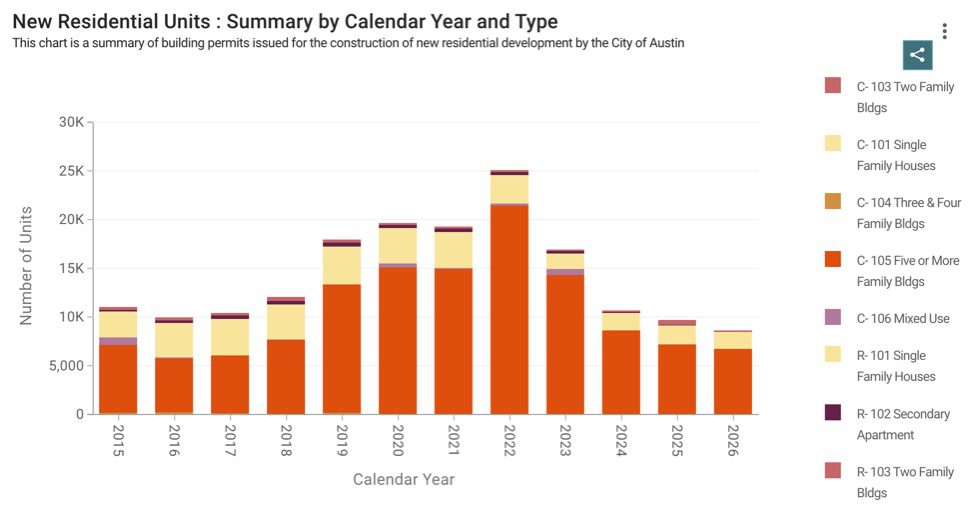
In short, H.O.M.E. and other pro-density code amendments didn’t create the building boom and aren’t related to the lower housing costs caused by the building bust.
But the City is undeterred by H.O.M.E.’s shortcomings and is doubling down. The City is now clamoring for even more houses per lot and commercial businesses in front yards. This seems to be a search for a higher tax base, as though that would somehow justify more displacement, more disruption, higher property taxes, and greater unaffordability.
You are not “pro‑housing” if your goal is to replace the very homes where people live and raise their families. Existing neighborhood communities are not barriers to housing — they are housing. They are more than a tax base to be maximized through deregulation and redevelopment; they are the fabric of a city, built by the people who already call it home.