On December 7, 2023, the Austin City Council adopted an ordinance allowing up to three units on a standard 5,750‑square‑foot single‑family lot. The Council gave it the acronym H.O.M.E., standing for Home Opportunities for Middle-Income Empowerment. On May 16, 2024, the Council adopted Phase 2, reducing the minimum lot size to 1,800 square feet and enabling a standard lot to be subdivided into three separate lots, each capable of supporting one home.
Confronted with the reality that neither phase of H.O.M.E. offered a realistic path for middle-income residents to purchase a home, the City quietly, without public explanation, redefined the acronym as Home Options for Mobility and Equity. Never mind that H.O.M.E. is not tied to transit stations or even bus stops and has no affordability component or non-displacement safeguards that equity demands. The Ministry of Truth at work.
Whatever the acronym, the City touts three units as “missing middle” housing that “can provide greater affordability and be more easily attainable by moderate-income families and individuals compared to new single-family homes by spreading the cost of the land across more units,” all while “fitting within residential neighborhoods.”
Let’s take a tour to see if these H.O.M.E.s would fit in next to your house.
|
|
|
|
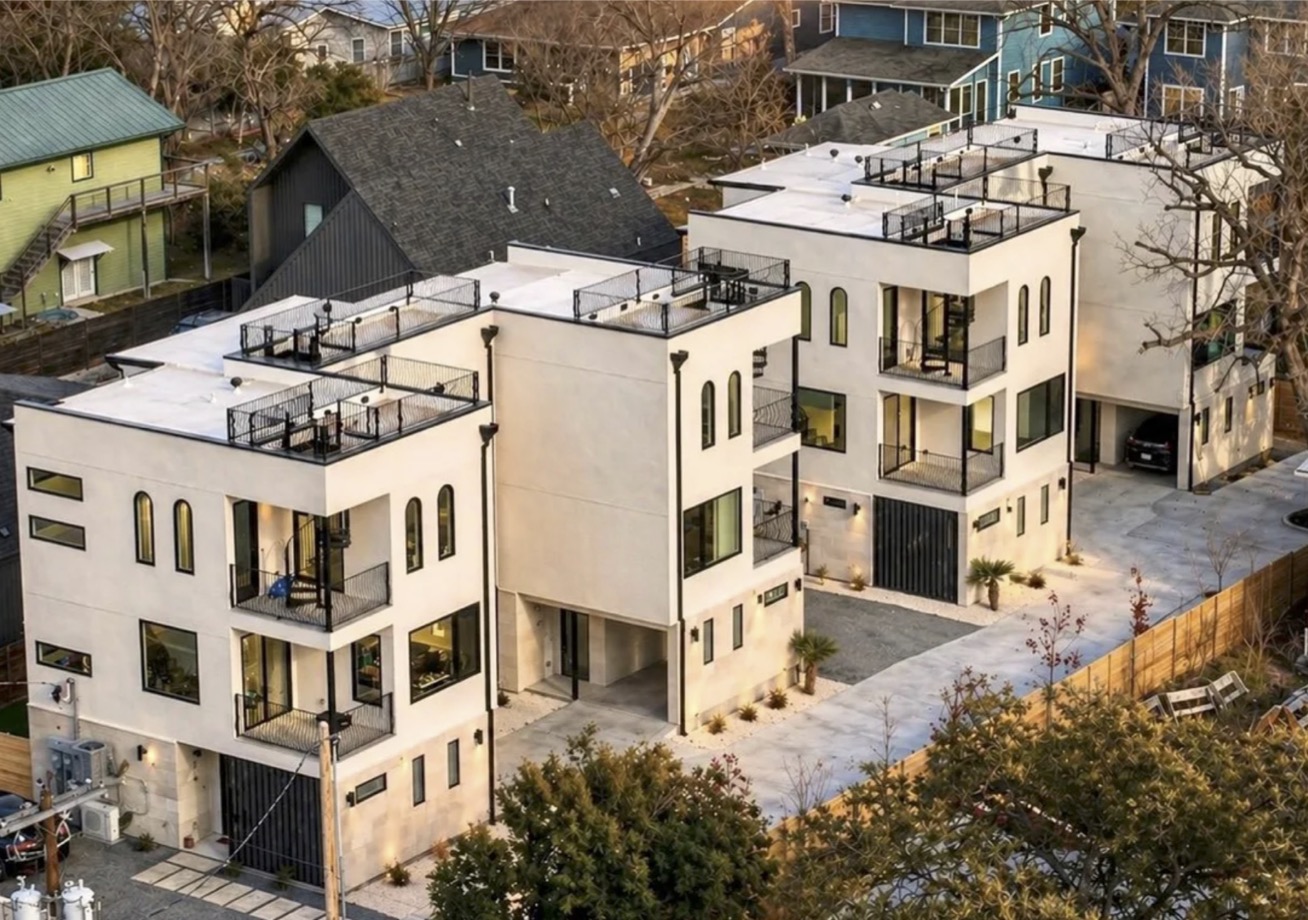
First Stop. Here are six units built under H.O.M.E. on a re-subdivided (SF-3) lot in the Brentwood neighborhood. They were originally marketed with the hook “the income potential of this property is limitless – short term rental, corporate rentals or Airbnb.” They are now “temporarily off market” but were initially listed at over $1 million each, prices inconsistent with “middle‑income” or “greater affordability.” The apparent lack of vegetation indicates impervious cover at a level inconsistent with residential compatibility and indifferent to the importance of Austin’s tree canopy in reducing local heat islands. |
|
|
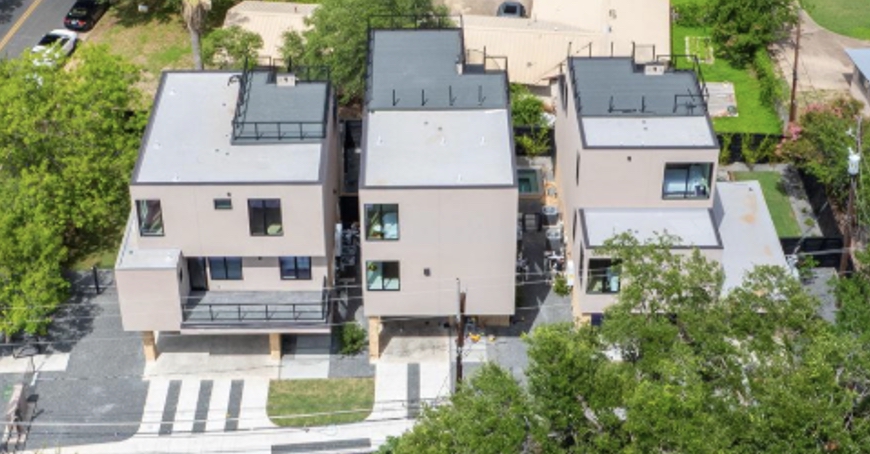
Second Stop. Our next stop is a three-unit H.O.M.E. development in Barton Hills. It replaced a 2,000‑square‑foot home with mature trees on a large lot with three new houses, each between 2,500 and 3,100 square feet. Marketed as just “steps away” from Barton Springs Pool, each home was listed at between $2 million and $2.5 million and has its own swimming pool. Unaffordability aside, the reader can decide whether the size and design of this “missing middle” housing “fits” within the neighborhood. |
|
|
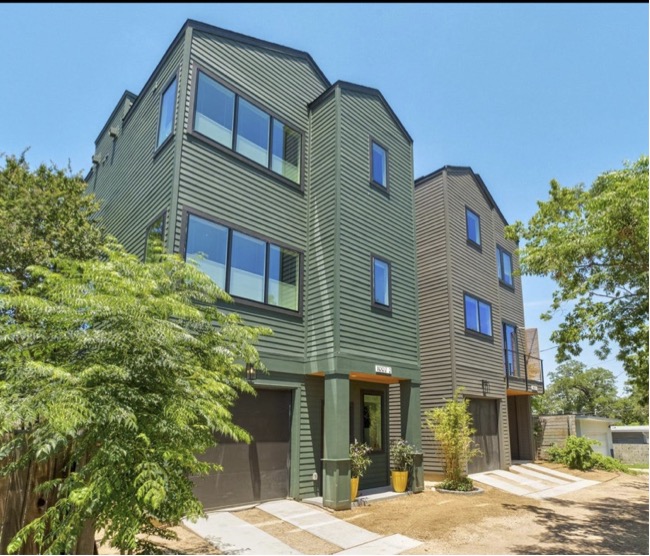
Third Stop. An east Austin neighborhood with towering H.O.M.E. units. The “missing middle” unit shown was listed at the “greater affordability” price of $1,000,000. Where did the cost savings from a lower per-unit land cost go? |
|
Not every H.O.M.E. development is prohibitively expensive or grossly incompatible, but the point is that any regulation or standard that would keep them from being so was stripped away or omitted in deference to the profit-driven market. Had the City wanted to promote affordable housing, or even middle-income housing, it could have restricted the size of H.O.M.E. units or required the third unit to be justified through affordability guarantees rather than gifted to investors and developers to increase their profits. Had the City cared whether a “missing middle” H.O.M.E. development “fit” within residential neighborhoods, it would not have wholly eliminated existing design standards and would not have granted a third unit as a matter of right. Instead, it would have required that additional units be shown to be – not identical to existing single-family homes – but at least not pointedly incompatible with them and, not indifferent, even hostile, to the input of the community. Families and individuals expected their representatives to protect them from the excesses of the market rather than green lighting those excesses. These developments will bring residents higher taxes on their land and devalue their homes at the same time, ripening communities for more high-profit development opportunities. Unfortunately, the City is just getting started. They want to extend the breadth and reach of H.O.M.E. in early December. The City is right now considering more units on lots, extending mixed-use buildings from corridors into residential neighborhoods, and allowing small buildings in the front yards of single-family homes to operate as small retail stores. Instead of continuing to undermine neighborhoods, the City should reform H.O.M.E. To be continued. |