Community Not Commodity

Convention Center: Is the Council trying to spend money before the public can tell them no?

On October 13, members of the public turned in a petition that would force a vote to pause the creation of a new convention center.    The Austin convention center, which was built in 1992 and doubled in size in 2002,  and won’t be paid off  until 2029 does not exist anymore, it is a hole in the ground.

Polling shows that the construction of a new convention center does not have much support in the community.   Even Kirk Watson said:

“This reminds me very much of my granddaughter…who recently took Legos and built a beautiful whatever it was, and I told her it was beautiful, and then she immediately destroyed it. I kind of feel like that’s what I’m — I remember trying to double the size of this convention center, and now we’re going to knock it down,” he said.

With a tentative vote coming why would the current City council put on Thursday’s October 23 agenda an item (#9) to approve issuing $650 million in revenue bonds for the project.   Another item (#11)  increases the general contract by $450 million, with a budget not exceeding  $1.65 billion.    This $1.65 billion is not the final price tag on construction costs (and excludes interest payments and operating losses in the tens of millions every year.

Wait, there is more:

Item 5 is $46 million in HOT revenue refunding bonds for the convention center, and Item 38 is $1.7 million for r strategic communications support and community outreach services for the redevelopment and expansion project for the Austin Convention Center.

Is the Council trying to spend money before the public can tell them no?

In July the city approved construction of a new 1,000 room hotel and convention center at the Circuit of the Americas.    Does the city need two new convention centers?
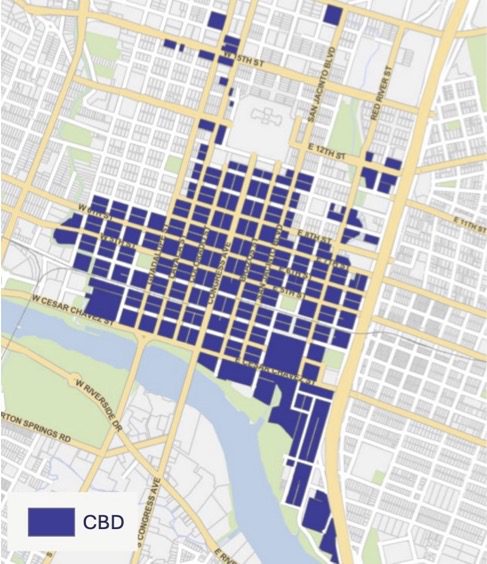
City Council to Consider Height Limits for Central Business District Zoning

Central Business District (CBD) is the zoning designation for office, commercial, residential, or civic uses located in the downtown area as show on the map.  CBD zoning has no height limit and limits development to no more than an 8:1 floor-to-area-ratio (FAR). This means that for example, on a 10,000 square feet lot, the building floor area can be at most 80,000 square feet.  To build anything above the 8:1 FAR limit, developers must participate in the Downtown Density Bonus program.  The program requires that either on-site affordable units are provided or a fee-in-lieu is paid to provide for affordable housing in another location.  According to the Austin Density Bonus Program Assessment published in December 2024, the Downtown Density Bonus was established in 2013.  While very few on-site affordable units have been built, the program has generated more than $27 million dollars in fee-in-lieu payments that have been used by the city to build affordable housing units in other locations.  On an annual basis, the Downtown Density Bonus program generates 70% of all affordable housing fee-in lieu payments in Austin.

Senate Bill 840 (SB 840) was passed by the Texas Legislature during the 2025 session.  The bill allows multifamily and mixed-use residential developments in commercial zones (including CBD) to build to a height that is the maximum of 45 feet or the height allowed for commercial uses on the site.  FAR limits are specifically prohibited by SB 840.  This means that since September 1, 2025, when the bill was enacted, projects with CBD zoning can be built with no size limit and no fee-in-lieu requirement.  To quickly deal with the loss of the 8:1 FAR limit, staff has proposed to impose a height limit.  However, instead of proposing the 210 feet limit that would be equivalent to an 8:1 FAR, the staff and the Planning Commission recommend a 350 feet limit.  Every single foot of increased entitlement above a 210 feet maximum is a gift to developers and takes away money that would go into the Affordable Housing Trust fund.  This would be undesirable at any time, but especially inappropriate now when the City Council can’t balance the City budget without a tax rate election.  In addition, keeping the base height equivalent to 8:1 FAR ensures that gatekeeper requirements such as Great Streets continue to be mandatory for most projects.

Do You Love Austin Taxes so Much? Taxes and Affordability

Beginning October 20, Austin residents will go to the polls to vote on the 16% property tax rate increase proposed by the City of Austin. The item will appear on the ballot as Proposition Q. Austin is the first large city in Texas to propose a Tax Rate Election (TRE) for its city budget.  If Prop Q passes, it will set the new permanent tax floor for Austin.  It is not a one-time increase to cover shortfalls – it is the tax level from which future increases will be calculated.

The City of Austin is $33 million short of the funding for its stated community goals. Yet, it is proposing a TRE that will raise $109.5 million (three times that amount).    Even with the utilities removed, Austin has the highest per capita taxes in Texas.   Excluding the utility portion of the Austin budget, Austin will tax at a rate of $3,630 per capita, while Fort Worth, the city closest in population, taxes at $2,758 per capita. Austin’s rate is 30% higher, and our tax per capita has been increasing steadily.  The TRE tax increase, while funding some commendable programs, will undeniably make Austin more unaffordable for residents, whether they own or rent their homes. Same for local businesses.

After being sold one thing and delivered another—looking at you, Project Connect shrinking light rail —many Austinites may understandably wonder:   Will the city actually spend this money the way they say they will?

As lower and middle-income individuals and families grapple with the rapidly increasing cost of living in Austin (including utility rates and taxes from multiple entities and taxing districts), many people may question why the city doesn’t adopt the same belt-tightening measures that its residents are forced to adopt (do we really need a new convention center?)    Why didn’t the City Council commission an external audit to find inefficiencies and save money?   Houston had an external audit and saved $120 million.

Will the council’s* legacy be “We spent the most!”  (*Note: Council Member Marc Duchen was the lone vote against the TRE.)

More Information:

City of Austin Budget and Tax Rate Overview

The Austin Independent:   “The Silence of the Shams” and “The Inherent Tension” Between Taxes and Affordability – Plus a Look at Campaign Contributions in the Prop Q Election”

Austin American-Statesman “We wish we could support Austin’s Prop Q. Here’s why we can’t endorse it”  and “For Austin homeowners, every tax hike comes from the same wallet”.

Watch More Affordable Austin statements, including Gonzalo Barrientos,  Ellen Wood, Marc Duchen, Steven Brown, Ora Houston, and Robin Rather (among others).

Austin Neighborhoods Council Statement on the TRE.

Early voting: October 20 – 31

Election day: Tuesday, November 4

Travis County polling locations

Caffeine First

With a $30 million budget shortfall and urgent challenges facing both Austin and the nation, what’s the priority for some City Council members? —housing instability, crumbling infrastructure, widening inequality?

No, it is walkability to a coffee shop.   No, we are not kidding.

A homemade cup of coffee can cost around 26 cents, and the average cost of a coffee shop cup is between $2.99 for a simple cup and $5.53 for a cappuccino.   Austin has hundreds of Coffee shops.  Yet, on the October 9th agenda, there is a resolution (Item 24)) directing the City Manager to consider land use code amendments to minimize zoning barriers to and encourage accessibility of coffee shops, cafes, and coffee trucks in the City’s residential areas.

“WHEREAS, many neighborhoods in Austin do not currently have access to coffee within walking distance” – Resolution

They believe that Austin residents, whom they imagine are happy with H.O.M.E. (three houses on a lot and tiny lots), commercial uses with no parking requirements, and the greenlighting of STRs everywhere, can’t live without a coffee shop or café next door.

Who is crusading this?   It is led by Ryan Alter, joined by Jose Velasquez, Paige Ellis, and Mike Siegel.

This really isn’t about coffee beans. It is a way to open the door to commercial and retail uses in neighborhoods without public input.

We all enjoy a cup of joe, but let’s first discuss traffic, parking, and what will be coming next door to the coffee shop.

City Acts to Modify Acuna Injunction

In 2020, a Travis County District Judge struck down several City of Austin comprehensive zoning ordinances known as CodeNext, finding that they violated Chapter 211 of the Local Government Code because the City enacted them without providing proper notice or honoring protests and committed other legal violations.  The decision was upheld on appeal.  Later the Court awarded Plaintiffs their costs and attorney’s fees.

Bills were filed at the Legislature this year (sponsored by Nosek’s Texans for Reasonable Solutions) and managed to procure several amendments to the Local Government Code that it maintains in a recently filed motion justify modification of the District Court’s Permanent Injunction.  The Plaintiffs deny that any modification is necessary or appropriate at this time.

The City’s motion is set for a 1.5 hour hearing on Tuesday, September 16 at 2:00 p.m. in the Travis County Courthouse. The case has not yet been assigned a Judge to hear the City’s motion, but it is expected that Judge Soifer will make that assignment after 2:00 pm in the 345th Judicial District Court (Courtroom C on the 10th Floor).  If you wish to attend, you should also check the digital bulletin board near the lobby elevators.