The City is proposing a new density bonus program to replace DB90 – the provision that allows an additional 30 feet of building height above the base zoning (up to 90ft) on commercial property in exchange for a small percentage (10%) of affofdable units. The city says that these categories will be available for “future City-initiated areawide rezonings as directed by Council. The proposal was supposed to be a reform. It bitterly disappoints. To understand why, a brief history is required.
At its May 22, 2025, meeting, the City Council considered a request to upzone the market-affordable Acacia Cliffs apartments under the Density Bonus Program (DB90). This change would trigger the future demolition of the property and the displacement of its tenants. Before testimony began, Mayor Watson acknowledged serious problems with DB90, calling it an “extremely unhappy experience” with “significant unintended consequences,” and likening it to “swinging an axe.” He proposed further study and revision of the program. Council Member Fuentes added that she was particularly interested in “looking at the one-for-one replacement on affordable units” under DB90. For context, the Council has approved ninety DB90 combining‑district upzonings across the city (see the map).
Without waiting for the ordered study and revision, on June 5, the Council lowered the axe. It granted the applicants’ DB90 rezoning request, enabling, even incentivizing, a redevelopment that will result in a net loss of 210 affordable housing units. The city has now unveiled
its proposed reforms in a draft of the new code, a memo, and a presentation. The proposal would replace
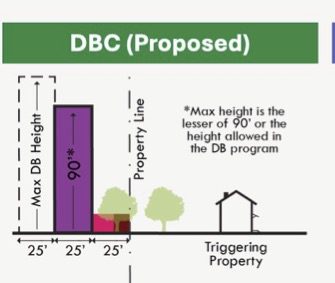
DB90 with 5 new density bonus districts and a new nomenclature: DBCBase, DBC15, DBC30, DBC45, and DBC60. Unlike DB90, the numbers do not represent the maximum height of the structure but the additional height available, e.g., DBC60 adds 60ft. In local and general office zoning, for example, the with-bonus height under DBC60 would be 105 and 120 ft, respectively, at least doubling their base heights. DBC45 would yield 90 and 105 ft., respectively – significant added height with no added compatibility requirements.The proposed compatibility standards would allow a 90‑foot building 25 feet from a single‑family lot line, and a 120‑foot building 50 feet from that lot line.
The proposal would also extend density‑bonus eligibility to the Neighborhood Office (NO) district — the commercial district historically intended to be most compatible with residential neighborhoods. Under state law, it currently has an allowable height of 45.’ Under DBC60, NO‑zoned properties could reach 105 feet. (45 + 60).
In their table of equivalencies, the city shows that several of the new density bonus categories are equivalent to the automatic upzonings created under last year’s Equitable Transit-Oriented Districts (ETOD). 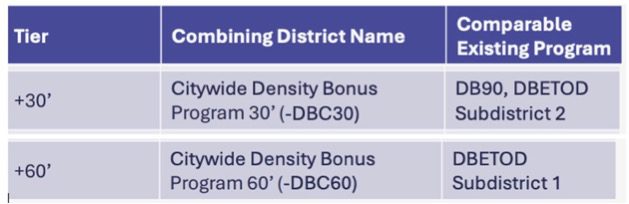 But if ETOD’s special height allowances were intended to attract “transit supporting” density to locations near transit, doesn’t offering comparable heights on commercial property across the city undermine that rationale?
And returning to Council Member Fuente’s call for one-to-one replacement units when naturally occurring affordable housing is being upzoned, how does the new proposal fare? The city’s draft states that a developer must replace the number of units affordable to someone earning 70% of Austin’s MFI, with units with the same number of bedrooms. That sounds good until the next section, which caps the affordable units at no more than 20% of the total units built (and, in some cases, at no more than the original 10%). So if you tear down a building with 300 affordable units, you would have to replace it with a building of at least 1500 units to replace the 300 affordable (20% max on replacement units). So there would always likely be a big loss in affordable units that these “reforms” were supposed to cure. And, it gets worse: you can also ask for a waiver that exempts you from the minimal replacement requirements! So while the new DBC code amendments act like they are being supportive of people living in existing affordable units, well, it is just an act.
In summary, the city’s proposal does not solve the three primary problems DB90 posed. When redeveloping existing multi-family housing, it does not require replacing the affordable units, but only a token amount. Second, while it laudably offers multiple height options, some with maximum heights of less than 90ft, most will result in the same or even greater height than allowed under DB90. Third, it does nothing to address the incompatibility of the DB90 zones adjoining or in neighborhoods, and by including the Neighborhood Office district, it widens that incompatibility to zoning districts intended to be compatible with neighborhoods.
Postscript: One can always count on the Planning Commission to create a more extreme version of any proposal. Their list of amendments to the proposal included:
- Adding another density bonus category up to DBC200 – for 200 ft bonus height.
- Allow these bonuses on MF-1, MF-2, MF-3 and MF-4 lots that are under a half acre. (see a map of this impact).
- Allow payment of a “fee-in-lieu” (in place) of actual affordable units in the project for all categories.
- “Consult the development community to calibrate affordability requirements of the program’s lower tiers.”
City Council is set to consider a resolution (Item #26) this week, on May 7. The resolution is broadly written, vague in key areas, and rests on several faulty premises, but its intent is clear: to expand the impact of the H.O.M.E. ordinances into all zoning categories where single-family homes are allowed. Here are some of their plans:
- Make H.O.M.E. available in Lake Austin (LA) and Residential (RR )zoning districts and PUD zoning districts like Mueller (every zoning district where single-family is permitted must be consistent with the H.O.M.E. ordinance). This would also impact areas with Neighborhood Conservation Combining Districts (NCCD) and Historic Districts, conditional overlays, and regulating districts. The effect is to override focused local planning.
- Reduce lot widths
- Allow front porches to extend to 7.5 feet from the front lot line
- No building coverage limits, only impervious cover limits
Notably, their proposal does nothing to promote affordability. For example, it fails to appropriately constrain unit sizes on small lots for that purpose.
These new code amendments are to be delivered by December 3, 2026. Sponsors of this Resolution include Council Members Laine, Vela, Velasquez, Qadri and Alter (who added a motion to make subdivision of lots faster and cheaper).